
.png)
Can Sending a Gift Change Employee & Customer Behavior?
When used strategically, gifting encourages participation, reinforces positive actions, and motivates behaviors that help organizations achieve their goals.
From workplace safety and AI training to attendance and customer loyalty, organizations are using meaningful gifting to reinforce the behaviors that drive results.
Organizations are using employee gifting and customer gifting as tools to encourage:
- Workplace safety
- AI training completion
- Professional certifications
- Customer referrals
- Customer onboarding
- Customer loyalty
- Product adoption
- Employee and customer advocacy
The key is rewarding behaviors, not just outcomes.
We call this behavioral gifting. It centers on using meaningful gifts to reinforce actions that drive outcomes.
Companies aren’t just celebrating employees and customers. They encourage participation, learning, safety, loyalty, innovation, and growth.
Organizations want employees to complete AI training.
They want customers to participate in loyalty programs.
They want stronger employee safety scores and higher customer retention rates.
The challenge isn’t convincing people that these things are important.
The challenge is getting busy people to make time for them.
Anyone who has ever clicked “Remind Me Later” on a mandatory training email recognizes the problem.
Awareness and action are not the same.
This is where employee and customer gifting become powerful strategies.
The most effective gifting programs don’t just recognize what employees and customers have done.
They reinforce what organizations want employees and customers to do repeatedly.
That’s a very different, but effective, way to think about gifting.
Gifting Isn’t Just Recognition
The most effective gifting programs don’t just recognize what employees and customers have done.
They reinforce what organizations want employees and customers to do repeatedly.
The idea isn’t as unusual as it sounds.
According to Snappy's 2026 Workforce Study, 88% of employees who receive gifts from their employer say those gifts increase engagement and collaboration. Additionally, 84% believe companies should recognize employees with gifts, while 73% say personalization is the most important factor in making recognition feel meaningful.
Employees aren’t just asking to be recognized. They’re responding to recognition in measurable ways.
Why Behavior Change Matters More Than Ever
Organizations are asking more from employees and customers than they were five years ago.
Employees are learning AI tools, adapting to new technologies, working across distributed teams, and navigating constant change.
Customers are evaluating more options, switching products more easily, and expecting more personalized experiences.
For both groups, success increasingly depends on participation.
The challenge isn’t in creating programs.
It’s getting people to engage with them.
Organizations are looking beyond traditional recognition and loyalty strategies toward approaches that actively encourage participation.
Why Behavior Change Matters for Employees and Customers
Companies are not struggling with a lack of initiatives.
They are struggling with participation.
Employees should complete training.
They should experiment with AI tools.
They know there are safety procedures they need to follow.
Similarly, customers know they have loyalty points to spend.
They should try the new feature.
They should finish onboarding.
The challenge isn’t awareness.
The challenge is action.
Every HR leader has launched a program they were excited about, only to discover half the organizations somehow missed all seven reminder emails.
If you’re currently rolling out AI training, cybersecurity training, compliance training, leadership training, or wellness initiatives, you’re nodding along right now.
The modern workplace is asking employees to learn, adapt, and change faster than ever before.
On a similar front, every Marketing leader oversees high-concept loyalty campaigns targeting customers with perks and points, only to watch engagement decline.
If you’ve ever lost sleep over choosing the perfect creative to email at the exact right time to garner as much customer interest as possible, you know how tough pushing the right action can be.
The question isn’t:
“How do we tell people what to do?”
The question is:
“How do we motivate people to actually do it?”
That’s where employee and customer gifting is a powerful tool.
The Biggest Mistake Organizations Make With Incentives
Most organizations reward outcomes.
Effective organizations also reward behaviors.
What Not To Reward
- Zero incidents
- Perfect attendance
- No customer churn
What To Reward
- Hazard reporting
- Training participation
- Customer referrals
Why Gifting Works for Behavior Change
Snappy’s Workforce Study found that personalization is the single biggest driver of meaningful recognition, with 73% of employees identifying it as the factor that makes appreciation feel genuine.
That’s important because behavior change is ultimately about attention.
Gift recipients are more likely to remember, value, and repeat behaviors that receive meaningful recognition.
A generic reward may be forgotten.
A thoughtful gift is personal.
- Gifts are memorable
- Gifts feel personal
- Gifts create emotional connection
- Gifts reinforce positive behaviors
- Gifts are associated with the giver
Why Gifts Work Differently Than Cash
When organizations think about incentives for customers and employees, they default to cash, points, and discounts.
However, people don’t always behave as logically as spreadsheets would like us to.
Behavior change isn’t just about rewards.
It’s about reinforcement.
A thoughtful gift sends a message:
“We noticed.”
“We appreciate this.”
“This matters.”
That is a very different message from the one that yet another transaction provides.
The goal isn’t to buy behavior.
The goal is to reinforce it.
Don’t Use Gifting Backwards
This is where many companies miss an opportunity.
In most cases, gifting happens for a milestone:
- Work anniversaries
- Birthdays
- Promotions
- Holidays
These moments are all important.
However, they are retrospective.
Smart organizations are thinking about gifting differently.
Instead of only asking: “What should we celebrate?”
They’re asking: “What behaviors should we encourage?”
That shift changes everything.
Suddenly, gifting becomes more than a recognition tool.
It becomes a way to reinforce actions that help employees and customers succeed.
What Behaviors Can Gifting Influence?
One of the most common questions when it comes to using gifting to motivate employees and customers is: “What should we actually incentivize?”
The answer isn’t outcomes.
It’s behavior.
The best gifting programs reinforce actions that customers and employees can directly control.
For employees, gifting can be used to encourage:
Workplace Safety
- Reporting hazards
- Completing inspections
- Participating in safety discussions
- Earning certifications
AI Training & Technology Adoption
- Completing AI training programs
- Attending workshops
- Sharing successful use cases
- Helping colleagues learn new tools
Learning Development
- Finishing courses
- Earning certifications
- Participating in mentorship programs
Workforce Engagement
- Referring candidates
- Participating in wellness programs
- Sharing knowledge with teammates
- Contributing to company culture
For customers, gifting can be used to encourage:
Adoption & Product Education
- Completing onboarding programs
- Activating key product features
- Attending training sessions
- Earning product certifications
Loyalty & Retention
- Renewing subscriptions
- Expanding product usage
- Participating in customer success reviews
- Reaching loyalty milestones
Advocacy
- Providing testimonials
- Participating in case studies
- Speaking at events or webinars
- Referrals
Engagement
- Sharing success stories
- Creating user-generated content
- Participating in social campaigns
- Celebrating partnership milestones
Notice a pattern?
These are all actions customers and employees can directly influence.
Why is that important? Well, effective incentive programs focus on creating behaviors, not reflecting on performance.
Employee Gifting Example: AI Training
Right now, HR teams are all talking about one challenge: AI adoption.
Companies are investing in AI tools, but software adoption doesn’t happen automatically.
Employees need training and guidelines.
They need confidence.
They need opportunities to experiment.
Most importantly, they need motivation.
No one is excited when a mandatory training session shows up on their calendar.
It’s not because employees are opposed to training.
They’re opposed to another “must-do” added to their day without explanation.
Companies need employees to learn new skills faster than ever before.
The urgency is real.
It creates opportunities.
Rather than rewarding outcomes, organizations can recognize participation.
Employee gifting can reinforce:
- Completing AI training programs
- Participating in hack-a-thons
- Attending workshops
- Knowledge sharing
- Becoming internal champions
The goal is to create momentum around learning.
Recognition helps make that learning visible.
Customer Gifting Example: Product Adoption
Customer success teams are facing a challenge that feels surprisingly similar to AI adoption.
Companies invest significant time and money building products, features, tools, and resources designed to help customers succeed.
However, product adoption isn’t automatic.
Customers need onboarding.
They need training.
They need confidence.
They need a reason to explore new features and capabilities.
Most importantly, they need motivation.
Customers do not want to spend time they don’t have completing extensive onboarding modules or watching tutorials.
It’s not because they don’t care about the product.
It’s because they are extremely busy.
The challenge isn’t getting customers to buy.
The challenge is in getting customers to engage.
This is an opportunity.
Rather than waiting until renewal time to recognize loyalty, organizations can use gifting to encourage participation throughout the customer journey.
Customer gifting can reinforce:
- Completing onboarding goals
- Joining training workshops
- Participating in social campaigns
- Referring new customers
- Providing case study data
The goal is to create momentum around adoption.
Gifting helps make participation visible.
Customer gifting is often viewed as a thank-you strategy. Increasingly, organizations are using it as an adoption strategy.
When customers engage more deeply with a product, they’re often more likely to realize value.
A Real-World Example: How Volkert Elevated Safer Behaviors
Volkert, a leading engineering and environmental consulting firm with more than 1,400 employees across 60 locations, and a Snappy customer, has had strong success using gifting as a behavior-change tool.
Volkert already had strong safety systems in place when they started working with Snappy.
The company had training programs, telematics, scorecards, and compliance processes.
What they wanted was a better way to recognize and encourage proactive safety behaviors.
Volkert launched a safety incentive initiative that combined meaningful gifting, recognition, gamification, and visibility.
The results were significant.
As of 2025, the company achieved:
- 21% reduction in total auto accidents
- 40% reduction in incident rate per mile
- Increased OSHA certifications
- More employee-led safety discussions
- Stronger employee engagement and morale
The key?
The gifts didn’t create safety.
The gifts reinforced the behaviors that support safety.
That’s a powerful difference.
Can Companies Incentivize Behaviors for Office & Distributed Teams?
Yes. The same principles apply whether someone works in a truck, a warehouse, a hospital, a manufacturing facility, or behind a laptop.
For frontline teams, gifting can reinforce:
- Safety participation
- Certifications
- Attendance
- Equipment inspections
For desk-based employees, gifting can reinforce:
- AI training
- Cybersecurity training
- Customer service initiatives
- Knowledge sharing
The behavior may change, but human nature doesn’t.
People are more likely to repeat actions that are seen and appreciated.
This can be incredibly valuable for distributed teams since managers don’t always have visibility into everyday contributions.
Recognition is very helpful in closing that gap.
A Framework For Using Gifting To Influence Behavior
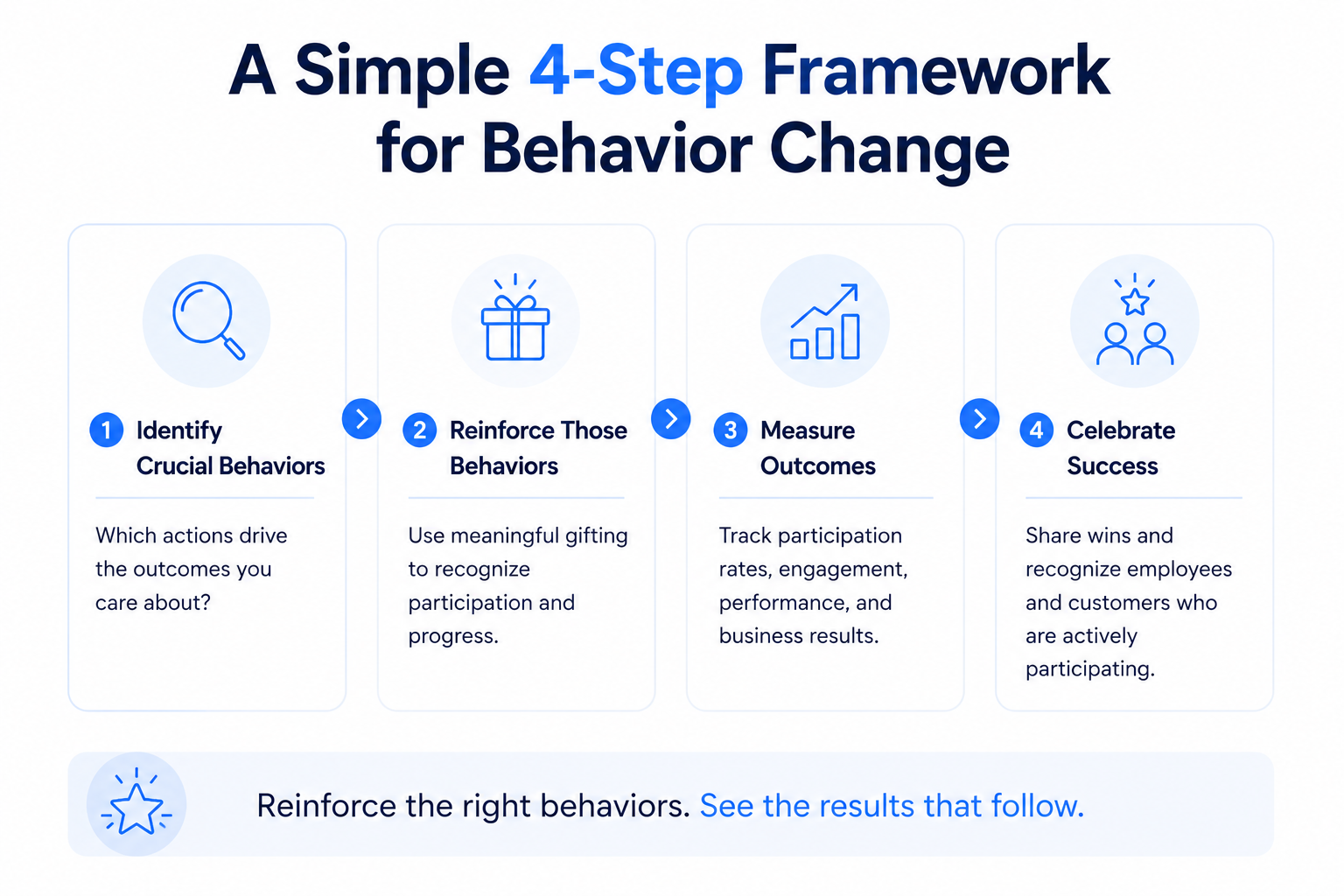
1. Identify Crucial Behaviors
Which actions drive the outcomes you care about?
2. Reinforce Those Behaviors
Use meaningful gifting to recognize participation and progress.
3. Measure Outcomes
Track participation rates, engagement, performance, and business results.
4. Celebrate Success
Share wins and recognize employees and customers who are actively participating.
It’s simple.
It’s scalable.
It’s effective.
Employee & Customer Gifting Is About More Than Appreciation
Employee and customer appreciation will always be important.
The business impact is significant.
According to Snappy’s Workforce Study, employees who feel motivated are more likely to engage with customers, collaborate with teammates, innovate, and take on new projects.
That’s why the conversation around gifting is expanding beyond appreciation.
Organizations are using gifting as a tool to influence participation, reinforce positive behaviors, and help people succeed.
Employees and customers want to feel valued.
They want to be recognized.
Organizations are discovering that gifting can do more than celebrate milestones.
It reinforces behaviors.
It encourages participation.
It supports training and learning.
It strengthens safety cultures.
Most gifting programs celebrate what employees and customers have already done.
Effective gifting programs encourage what they should do next.
That’s what Volkert discovered.
The company didn’t simply create a safer workplace.
It created a culture where employees felt seen, appreciated, and motivated to do the right thing every day.
In a workplace where organizations are asking employees to learn new skills, embrace new technologies, and adapt to constant change, that may be one of the most valuable uses of gifting yet.
FAQs About Gifting & Behavior Change
Can employee gifting influence behavior?
Yes. Organizations frequently use gifting to encourage participation in training, workplace safety programs, certifications, referrals, or other initiatives.
Can customer gifting increase loyalty?
Yes. Gifting can reinforce behaviors such as renewals, referrals, product adoption, and participation in loyalty programs.
What behaviors should organizations incentivize?
The most effective programs reward actions that employees and customers directly control, such as completing onboarding, attending training, reporting safety concerns, or participating in surveys.
Can gifting help increase AI training participation?
Yes. Many organizations use gifting to encourage employees to complete AI training, attend workshops, and share best practices.

