
There is a very specific HR experience that nobody prepares you for.
You spend weeks planning an employee appreciation initiative only to watch someone casually leave the branded water bottle behind in the conference room a day later.
Another scenario? You realized that the company spent thousands of dollars on “culture building” gifts that employees politely thanked you for before immediately asking, “Wait…did everyone get the same thing?”
Employees are incredibly good at spotting the differences between appreciation that feels thoughtful and appreciation that feels like it came from a spreadsheet.
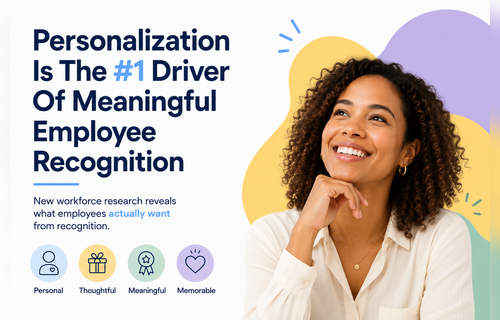
According to Snappy's 2026 Workforce Study, that difference comes down to one thing. Personalization.
Key Takeaways From Snappy’s 2026 Workforce Study
- Personalization ranked as the #1 driver of meaningful employee recognition
- 88% of employees say gifts improve engagement and morale
- 72% say anniversary gifts would make them more likely to stay at their company
- Only 32% of employees say companies consistently get employee appreciation right
- Employees are more likely to respond positively to recognition that feels personal, thoughtful, and relevant.
- Recipient-choice gifting helps organizations personalize employee recognition at scale
- Personalized employee gifting strengthens employee engagement, workplace culture, and retention.
What is Personalized Employee Recognition?
Personalized employee recognition is a strategy that tailors appreciation, gifts, rewards, or experiences to individual employees based on their preferences, milestones, interests or contributions.
Unlike generic employee recognition programs, where every employee receives the same experience, personalized employee recognition helps appreciation feel more thoughtful, relevant, and meaningful.
Modern personalized employee recognition programs often include:
- Recipient-choice gifting
- Personalized notes
- Work anniversary gifts
- Employee onboarding gifts
- Curated employee gift collections
- Experiences tailored to personal interests
- High-quality swag employees will actually use
As workplaces become more distributed and automated, personalized employee recognition has become increasingly important for improving employee engagement, employee retention, workplace culture, and employee satisfaction.
Employees Want Recognition That Feels Personal, Not Performative
Snappy surveyed 1,500 full-time employees across industries in the United States to better understand what drives employee engagement, workplace connection, and retention.
The biggest finding?
Personalization ranked as the #1 driver of meaningful employee recognition.
When recognition feels genuine and memorable, employees say it comes down to:
- 73% - Personalization
- 57% - Thoughtfulness of the gesture
- 36% - Public acknowledgement
- 29% - Timing
That tells us something important about today’s workplace:
Employees don’t just want recognition. They want recognition that feels like it was meant for them.
Honestly? Most employees have gotten very good at identifying when appreciation feels off.
They know when appreciation is rushed.
They know when a manager copied and pasted the same message to an entire team.
They know when “employee recognition” is really just a quarterly box that needs to be checked
They definitely know when the company ordered 800 identical, low-quality backpacks because someone needed to use the remaining budget before Q4 closed.
Employees aren’t looking for over-the-top celebrations.
They want effort. Thoughtfulness. Meaning. Some small signal that the company sees them as a person instead of an employee ID number on a dashboard.
As Hamutal Oren-Fox, Snappy’s Chief People Officer, explains: “Recognition is the intentional acknowledgment of a person’s actions, efforts, or impact. At its core, recognition answers a universal human need: to feel appreciated, valued, and seen. When recognition is done thoughtfully, it operates on three distinct and compounding levels: rewards, positive reinforcement, and appreciation. Each layer goes deeper, and each one creates a stronger and more lasting impact.”
Why Personalized Employee Recognition Matters
Work has changed drastically over the past few years.
Burnout is high. AI and automation are reshaping how employees communicate, collaborate, and experience day-to-day work environments.
Many employees now spend more time interacting with systems than with actual human colleagues.
Performance reviews are templated. Internal communication is automated. Chatbots answer questions that managers used to answer. Productivity tools track everything from response time to meeting attendance.
Efficiency may help businesses move faster, but it can also create workplaces that feel emotionless and unsupportive.
That’s why personalized employee recognition matters so much right now.
Employees don’t need another automated touchpoint pretending to be human.
They want moments that feel real.
- A thoughtful gift just for them.
- A meaningful message (not an emoji response).
- Their manager recognizes something specific they accomplished.
- A work anniversary that feels genuinely celebrated.
These moments create emotional connections inside workplaces that increasingly feel transactional.
What about Business impact? It’s significant.
According to Snappy’s Workforce Study:
- 88% of employees say gifts increase engagement and collaboration
- 72% say anniversary gifts would make them more likely to stay at their company
- Only 32% say companies consistently get employee appreciation right
That last stat is important.
Most organizations are actively trying to recognize employees.
The challenge is that many employee recognition programs accidentally become generic, repetitive, or emotionally disconnected from the people they’re supposed to celebrate.
Why Personalized Employee Recognition Improves Employee Retention
Personalized employee recognition improves employee retention because employees are more likely to stay at organizations where they feel seen, appreciated, and connected to workplace culture.
According to Snappy’s 2026 Workforce Study, 72% of employees say receiving anniversary gifts makes them more likely to stay at their company.
Personalized recognition helps:
- Strengthen emotional connection to the workplace
- Reinforce employee value
- Increase engagement
- Improve morale
- Support workplace culture
- Create stronger manager-employee relationships
- Make workplace milestones feel meaningful
As organizations compete for talent and navigate workplace burnout, personalized employee recognition has become an increasingly important employee retention strategy.
Some Employee Recognition Programs Are Disconnected From Feelings
Let’s say the quiet part out loud.
A lot of workplace recognition feels oddly corporate.
It’s not because HR teams don’t care.
It’s because so many traditional recognition platforms were built to prioritize operational ease first and employee experience second.
One gift for everyone.
One email template.
One giant shipping spreadsheet.
One overwhelmed HR team working to coordinate it all.
Somewhere along the way, recognition starts feeling less like appreciation and more like a logistics project.
This is one of the biggest reasons so many traditional employee gifting programs miss the mark.
Employees can tell when recognition feels transactional.
They know when the birthday message is automated.
They know when appreciation is performative.
They know when there is a “one size fits all” approach (literally and figuratively)
Unfortunately, a lot of workplace recognition has started feeling exactly that.
The Problem With Traditional Corporate Gifting
Traditional corporate gifting usually follows the same formula:
HR picks one item.
Deals with an overwhelming amount of boxes in their office.
Ships it to everyone.
Hopes for the best.
Sometimes it’s branded swag in a size no one actually ordered.
Sometimes it’s snack boxes that have gone stale.
Sometimes it’s wine, and half the team doesn’t drink.
The issue isn’t the gift giver.
The issue is the “one size fits all” style of gifting.
“One size fits all” doesn’t feel personal.
Personalization is what employees remember.
Traditional employee gifting also creates operational headaches for HR teams:
- Managing addresses
- Tracking inventory
- International shipping issues
- Employees receiving items they don’t want
- Sizing issues
- Budget waste
- Last-minute shipping chaos
Meanwhile, employees end up with another item they didn’t want and might not ever use.
This is why recipient-choice gifting has become such an important shift in modern employee recognition strategies.
What is Recipient-Choice Gifting?
Recipient-choice gifting is an employee gifting model where employees choose their own gift from a curated collection instead of receiving the same exact item as everyone else.
This approach helps employee recognition feel more personal while reducing unwanted gifts, administrative complexity, and wasted budget.
Recipient-choice gifting helps organizations personalize employee recognition at scale without creating additional operational complexity for HR and People teams.
A parent might choose noise-cancelling headphones
A remote employee might upgrade their home office setup
A wellness-focused employee can pick a massage device or fitness gear
A foodie might choose a cooking class
Same budget. Completely different experiences.
Recipient-choice gifting creates personalization without creating extra work.
That’s a major difference between modern employee gifting platforms and many traditional vendors.
Employee recognition isn’t just a fulfillment exercise.
It’s an emotional experience.
Employees will have a tangible memory of how their company’s recognition made them feel.
Modern Employee Recognition Needs Flexibility
One of the biggest myths in HR is that personalization creates operational complexity.
That used to be true.
Modern employee gifting platforms like Snappy have changed that completely.
Today, organizations can create scalable employee recognition programs that still feel individualized across:
- Employee onboarding
- Birthdays
- Work anniversaries
- Promotions
- Employee appreciation events
- Sales incentives
- Wellness programs
- Performance milestones
- Training incentives
- Holiday gifting
This flexibility matters because employees don’t work the same way anymore.
Some employees are remote.
Some are frontline workers.
Some travel constantly.
Some work night shifts.
Some want experiences.
Some want practical gifts.
Some want to upgrade something they already have.
Some want swag from their favorite brands like The North Face, Ray Ban, Yeti, and Under Armour.
Modern employee recognition programs need to reflect the reality that employees are different people with different lives.
That’s what makes recognition feel meaningful.
HR Teams Are Already Carrying Too Much
HR teams are exhausted.
Most People teams are already balancing hiring, retention, employee relations, internal communications, leadership requests, culture initiatives, compliance work, burnout concerns, and approximately 400 Slack and Teams notifications for “quick questions.”
Now they’re expected to improve employee engagement, strengthen workplace culture, and somehow make work feel more human in the middle of constant workplace change.
No wonder so many employee recognition programs default to generic solutions.
A lot of HR teams are simply trying to survive the week.
That’s why modern employee gifting platforms need to reduce complexity, not create more of it.
The best employee recognition programs help HR teams scale thoughtful employee experiences without adding more manual administrative work.
That includes:
- Flexible budgets
- Global delivery
- Personalized gift experiences
- Recipient-choice gifting
- Automated milestone programs
- High-quality branded swag options
- HRIS integrations
- Engagement visibility and reporting
But most importantly?
The best employee recognition programs feel human.
Employee Gifting is Not a “Nice to Have”
There was a time when employee gifting was treated like a perk.
Something reserved for the holidays
A leftover budget initiative
A once-a-year employee appreciation moment
That’s changed.
Today, employee gifting is a tool that positively impacts:
- Employee retention
- Employee engagement
- Collaboration
- Workplace culture
- Productivity
- Morale
- Manager effectiveness
- Employee brand
Employees expect organizations to recognize milestones and contribute in thoughtful ways.
Not because employees expect expensive gifts.
They want acknowledgement. They want to feel seen.
There is a difference.
People want to feel appreciated.
As work becomes increasingly automated, that emotional distinction matters.
The Future Of Employee Recognition Is More Human
AI will continue to change the workplace.
Automation will keep speeding things up.
Organizations will continue looking for ways to scale operations more efficiently.
None of that replaces human connection.
Efficiency does not create belonging.
Automation does not build workplace culture.
Faster workflows do not make employees feel valued.
Recognition fills that gap.
Not performative recognition.
Real recognition.
The kind that feels thoughtful. Relevant. Human.
That’s why personalization has become the most important driver of meaningful employee recognition.
Employees remember moments that feel intentional.
Employees may forget the “thank you” Slack.
They might not remember the pizza lunch.
They will move on quickly from the all-company appreciation email.
They will remember moments when they feel genuinely appreciated.
Tangible gifts are long-lasting ties to that appreciation.
FAQs About Personalized Employee Recognition
What is personalized employee recognition?
Personalized employee recognition is a strategy that tailors appreciation, rewards, gifts, or experiences to individual employees based on their preferences, contributions, or milestones. Personalized recognition helps employees feel more seen, valued, and connected to workplace culture.
Why does employee recognition matter?
Employee recognition improves employee engagement, workplace culture, morale, collaboration, and retention. Employees who feel appreciated are more likely to stay engaged and connected to their organization.
How does employee gifting improve employee engagement?
Employee gifting helps employees feel acknowledged and appreciated. According to Snappy’s Workforce Study, 88% of employees say gifts improve engagement and collaboration.
What is recipient-choice gifting?
Recipient-choice gifting allows employees to choose their own gift from a curated collection instead of receiving the same item as everyone else. This makes employee recognition feel more personal and relevant.
Why do employees prefer personalized gifts?
Employees prefer personalized gifts because they feel more thoughtful and meaningful. Personalized gifts reflect individual preferences and help recognition feel more authentic instead of generic.
Do employee gifts improve employee retention?
Yes. According to Snappy’s 2026 Workforce Study, 72% of employees say anniversary gifts would make them more likely to stay at their company.
What makes employee appreciation meaningful?
Employees say meaningful appreciation is driven primarily by personalization, thoughtfulness, authenticity, and relevance. Recognition feels more impactful when it reflects the individual employee and their contributions.
About Snappy’s 2026 Workforce Study
Snappy’s 2026 Workforce Study surveyed 1,500 full-time employees across industries in the United States in January 2026 to better understand the drivers of employee retention, employee engagement, workplace recognition, and workplace connection.

