
.png)
If you’ve ever worked in HR, you’ve probably had this experience.
You spend weeks helping a struggling employee get back on track. You coach a manager through a difficult conversation. You quietly resolve a conflict that could have spread across an entire team. You help an employee navigate a family crisis. You convince leadership to rethink a policy that would have created unnecessary friction.
And then…
Nothing happens.
Nobody notices.
Ironically, this means you definitely did your job exceptionally well.
The best HR work never generates fireworks. It prevents them.
This idea was at the heart of a recent conversation between Snappy’s director of People & Culture, Courtney Bock-Hencken, and HR expert Suzanne Lucas, better known as the Evil HR Lady. Together, they explore what it’s really like to work in modern HR: the emotional labor, the impossible decisions, the invisible wins, and the surprisingly funny moments that bond HR professionals.
The conversation was refreshingly honest.
No jargon. No promises for cure-all solutions. No magic tricks to solve every workplace challenge.
The throughline of every single topic was that HR is about people, and the acknowledgment that people are, wonderfully, humorously, and exhaustingly complicated.
At Snappy, conversations like this reinforce something we hear from HR leaders every day: the hardest parts of the job rarely appear on a job description.
HR Success Can Look Like Nothing Happened
HR leaders are navigating extremely complex issues at once. Hybrid work, AI adoption, evolving employment law, rising employee expectations, burnout, and economic uncertainty have dramatically expanded HR’s responsibilities. Understanding what modern HR leaders actually do, and how they do it, has never been more important.
To that end…
Every job has visible wins.
Sales closes deals.
Marketing launches campaigns.
Engineering ships new features.
Finance closes the books.
HR?
HR spends weeks ensuring other teams’ visible wins succeed.
As Suzanne said during the webinar, HR is a little like the CIA.
“When everything goes well, no one knows they’ve been there. When it goes poorly, the whole world knows.”
Employees rarely see the investigations that prevent larger issues.
Managers don’t always realize how much coaching happened before a difficult conversation.
Execs may never know which legal risk quietly disappeared because someone in HR flagged it and handled it.
The challenge is that HR often becomes less visible as it becomes more effective.
Navigating that challenge is incredibly important for HR professionals who focus so intensely on helping other people succeed.
Key Takeaways
- HR succeeds by preventing problems before they happen
- Great HR leaders balance empathy with objectivity
- The best HR professionals question assumptions instead of making them
- Respectful offboarding strengthens employer brand
- Supporting HR ultimately strengthens employee experience
One theme emerged repeatedly throughout the conversation: the strongest HR professionals aren’t necessarily the ones with the most technical expertise. They’re the ones who remain curious, question their assumptions, communicate consistently, and remember that every workplace policy ultimately impacts a person.
The Emotional Labor of HR
Emotional labor and how best to carry the weight were hot topics during the discussion.
Messages, calls, and meetings with employees cover everything from:
- Excitement
- Frustration
- Fear
- Family emergencies
- Career ambitions
- Financial concerns
- Career ambitions
- Burnout
- Healthcare stress
Sometimes all of this happens before lunch.
HR professionals absorb all of this while staying calm, objective, empathetic, and legally compliant.
That’s a lot of juggling and balancing.
Courtney described HR’s role as making thoughtful decisions that affect people’s livelihoods while often being alone in processing those confidential decisions. Leaders can ask HR for advice. Employees can ask HR for guidance.
Who does HR ask?
For many HR teams, especially teams of one, the answer is often no one.
That level of emotional isolation is something that is rarely discussed.
It’s one reason HR leaders consistently cite burnout as the biggest career challenge.
Supporting everyone else can leave very little room to be supported.
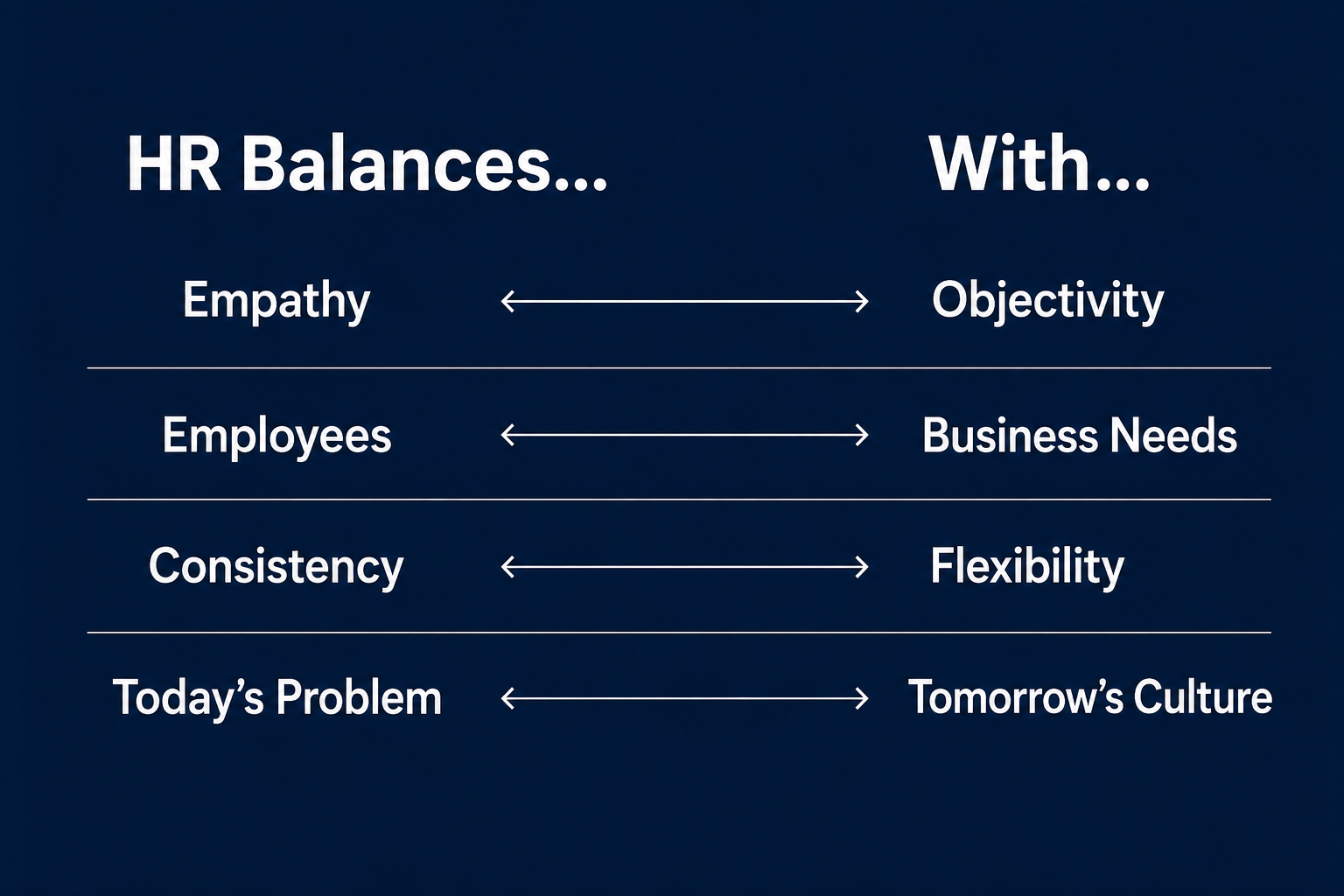
The Four Balancing Acts of Great HR
Every HR leader eventually learns to balance four competing priorities:
Great HR Starts With One Surprising Skill
Early in the conversation, Suzanne shared a story from the beginning of her career that perfectly illustrates what separates the good HR people from the exceptional ones.
Like so many people, she didn’t plan to work in HR.
Armed with a master’s degree in political science and hoping to become a trainer, she accepted a temporary administrative role in an HR department simply because she could type 110 words a minute.
Her first assignment?
Finish a compensation survey.
There was only one problem.
She had no idea what “exempt” meant.
“I literally had to ask my boss what exempt meant," she laughed.
It’s a funny story now.
It also highlights something every experienced HR professional learns very quickly:
Nobody starts out knowing everything.
The best HR leaders aren’t the ones who have every answer.
They’re the ones who stay invested and curious long enough to match the right answers to the right situations.
Meet People Where They Are. Not Where You Assume They Are.
Later in her career, Suzanne experienced a moment that fundamentally changed how she approached HR.
While working at a major supermarket chain, she was responsible for analyzing employee turnover.
One report kept puzzling her.
Employees were leaving after only a few days on the job.
It didn’t make sense.
The company paid better than its competitors. The jobs were stable. She couldn’t figure out why someone would quit almost immediately.
A more senior colleague shared an explanation that she’d never considered.
Some of these employees had never held steady jobs before.
They weren’t rejecting good work.
They were navigating an entirely unfamiliar experience.
That conversation left a permanent impression on Suzanne and forever shifted her perspective.
Instead of asking, “Why would someone do this?” she learned to ask, “What experiences are shaping this person’s perspective.
It’s an incredibly powerful shift, especially because HR isn’t really about policies.
It’s about context.
Every employee arrives with different experiences, expectations, fears, motivations, and definitions of what “normal” looks like.
The best HR leaders cannot assume everyone starts from the same place.
They meet people where they are.
It applies to every situation. It’s true whether you’re onboarding a first-time employee, coaching a new manager, leading organizational change, or investigating a workplace concern.
Empathy is essential.
It’s important to remember that empathy isn’t lowering standards.
It’s understanding the starting point before helping someone to take the next step.
How HR Makes Impossible Decisions
If empathy is the foundation of HR, decision-making is where things get complicated.
HR professionals face such a wide range of situations on any given day, and not every one of them has a clear answer.
Sometimes you’re balancing fairness with business needs.
Other times, you’re weighing one employee’s experience with another’s.
There are times when you’re navigating legal risk, cultural impact, and human emotions, all at once.
Courtney spoke very candidly about this tension during the conversation.
“There are moments where you’re making decisions that you know will deeply impact someone’s life,” she shared. “And you have to hold both empathy and objectivity at the same time.”
That’s not easy.
It’s one of the hardest parts of the job.
Suzanne reinforced this idea with a simple but powerful truth: HR isn’t about being liked. It’s about being fair.
That distinction matters.
If HR professionals tried to make everyone happy, they’d have no credibility.
Great HR leaders focus on consistency, transparency, and integrity. Even when, and especially when, the outcome is difficult.
This could mean:
- Leading an investigation with a result that doesn’t fully satisfy any of the involved parties
- Supporting a manager through a difficult termination decision
- Enforcing a policy that feels very rigid in the face of a very human situation
- Saying “no” when it would be easier to say “yes”
These are the moments that define HR leadership.
They are also nearly invisible to anyone outside the room where they are taking place.
The key, as both Courtney and Suzanne emphasized, is to stay grounded in principles rather than emotions.
Empathy helps HR professionals understand the situation.
Objectivity helps them navigate it.
Success requires both.
The “Yeah, But…” Problem Every HR Leader Faces
Everyone who has worked in HR for at least five minutes has heard it.
“Yeah, but…”
It usually comes after:
- Explaining a policy
- Outlining a new process
- Recommending a course of action
- Declining an unorthodox solution
“Yeah, but this situation is different.”
Sometimes it is.
That’s when HR professionals rely less on rules and more on judgment.
Courtney described this as one of the most nuanced parts of HR roles.
“Policies are important,” she said, “but people don’t live in policies. They live in real life.”
That means HR leaders are constantly interpreting how guidelines apply to messy, complicated, human situations.
Suzanne echoed this sentiment.
“There’s always a 'yeah, but,” she said. “Sometimes the 'yeah, but' is valid.”
The challenge is knowing when to flex and when not to.
If you’re too rigid, you lose trust.
If you’re too flexible, you lose consistency.
The best HR professionals develop an internal compass over time.
They ask:
- Is this an exception or a pattern?
- Are we being fair across similar situations?
- What precedent does this set?
- What’s the long-term impact of this decision?
It’s not about finding perfect answers.
It’s about making thoughtful decisions.
The Power of Great Offboarding
When employees think about HR, they often focus on hiring, onboarding, and engagement.
One of the most important and overlooked moments in the employee lifecycle is offboarding.
How someone leaves an organization matters.
A lot.
It shapes how departing employees feel in the moment.
It shapes the story of how they feel a few days or weeks later.
It influences whether they might return one day.
It impacts the morale of the team they leave behind.
Suzanne emphasized that offboarding isn’t just an administrative process.
It’s a human one.
“People remember how you treat them on the way out,” she said.
Courtney built on that idea with a perspective that resonated deeply.
“Offboarding is the last opportunity you have to show someone who you are as a company,” she explained. “It’s not just about paperwork. It’s about respect.”
That response can show up in simple but incredibly meaningful ways:
- Clear, compassionate communication
- Thoughtful transition planning
- Acknowledging contributions
- Providing support where possible
Even in difficult situations, like layoffs, the way HR handles the moment matters.
Employees won’t just remember what happened. They remember how it felt when it happened.
In today’s world of employer reviews, social media, and deep professional networks, details about once-very-personal experiences now become public quickly.
Great offboarding is good for everyone. Departing and remaining employees, as well as the business itself.
Who Supports the People Who Support Everyone Else?
Throughout the conversation, one question kept surfacing: Who supports HR?
HR is often the only support system for everyone else.
They’re the sounding board.
The mediator.
The advisor.
The steady presence in moments of turbulence.
That role can become very isolating.
Courtney shared more about this reality, explaining, “There’s a level of confidentiality in HR that can make it hard to share what you’re carrying. You’re holding a lot, and you can’t always talk about it.”
HR professionals need to prioritize building a support system of other HR professionals.
Whether it’s:
- Peer networks
- Memberships to industry groups
- Professional communities
- Mentorships
- HR friends (and family members!)
HR professionals need space to recharge, reflect, and feel appreciated.
When HR is supported, everyone benefits.
When HR is burned out, the entire organization feels it.
Company culture, especially around recognition and appreciation, is so important.
Not as a perk, but as a necessity.
At Snappy, we've spent years partnering with HR leaders, and one lesson comes up repeatedly: recognition isn't just for employees. HR professionals need it, too.
5 Lessons Every Leader (Not Just HR) Can Learn
While this conversation centered around HR, the insights extend to other roles.
In fact, many of the lessons Suzanne and Courtney shared apply to everyone in a leadership role.
Here are five that stood out:
- Prevention is Powerful: The best leaders don't just solve problems. They prevent them. That means investing time upfront in communication, clarity, and relationships, so issues don’t escalate later.
- Curiosity Beats Certainty: You don’t have to have all the answers. You DO need to ask good questions. Curiosity creates space for understanding. Understanding leads to better decisions.
- Context Matters More Than Assumptions: Every employee brings a different story. Great leaders take the time to understand those stories. Assumptions are often wrong…and costly.
- Consistency Builds Trust: People don’t expect perfection. They do expect fairness. Consistency in how you apply policies and make decisions is one of the fastest ways to build or lose trust.
- You Are Defined By How You Show Up in Hard Moments: Anyone can lead when things are easy. Real leadership shows up in difficult conversations, tough decisions, and moments of uncertainty. That’s where cultures are built.
Invisible Works Makes Everything Else Possible
At its core, HR is about creating the conditions for people to do their best work.
Sometimes that looks like a strong hire.
Sometimes that looks like a conflict resolved quietly and privately.
Sometimes it looks like nothing is happening at all.
That’s the whole point.
When HR is working well, the organization runs smoothly.
People feel supported.
Leaders make better decisions.
Teams stay focused.
People thrive in the workplace.
It may not always be visible.
It is always essential.

