
Leading HR organizations in the tech industry for over 20 years, I’ve had the privilege of working with brilliant people, transformative products, and strong, evolving cultures. For the past two years at Snappy, I’ve experienced something even deeper. As an HR leader who believes that every meaningful business transformation begins with people, I can say with conviction that Snappy has the power to transform not only how employees experience their day-to-day at work, but how people show up for one another both inside and outside the workplace.
As we approach Employee Appreciation Day, I want to share a perspective that sits at the heart of that transformation: the power of recognition.
There are three ideas I hope you take with you:
- Recognition works, and science proves it.
- Intentional leadership is essential for improving performance.
- Appreciation creates psychological safety, and psychological safety fuels long term engagement.
Let’s start at the foundation.
Recognition is the intentional acknowledgment of a person’s actions, efforts, or impact. At its core, recognition answers a universal human need: to feel appreciated, valued, and seen. When recognition is done thoughtfully, it operates on three distinct and compounding levels: rewards, positive reinforcement, and appreciation. Each layer goes deeper, and each one creates a stronger and more lasting impact.
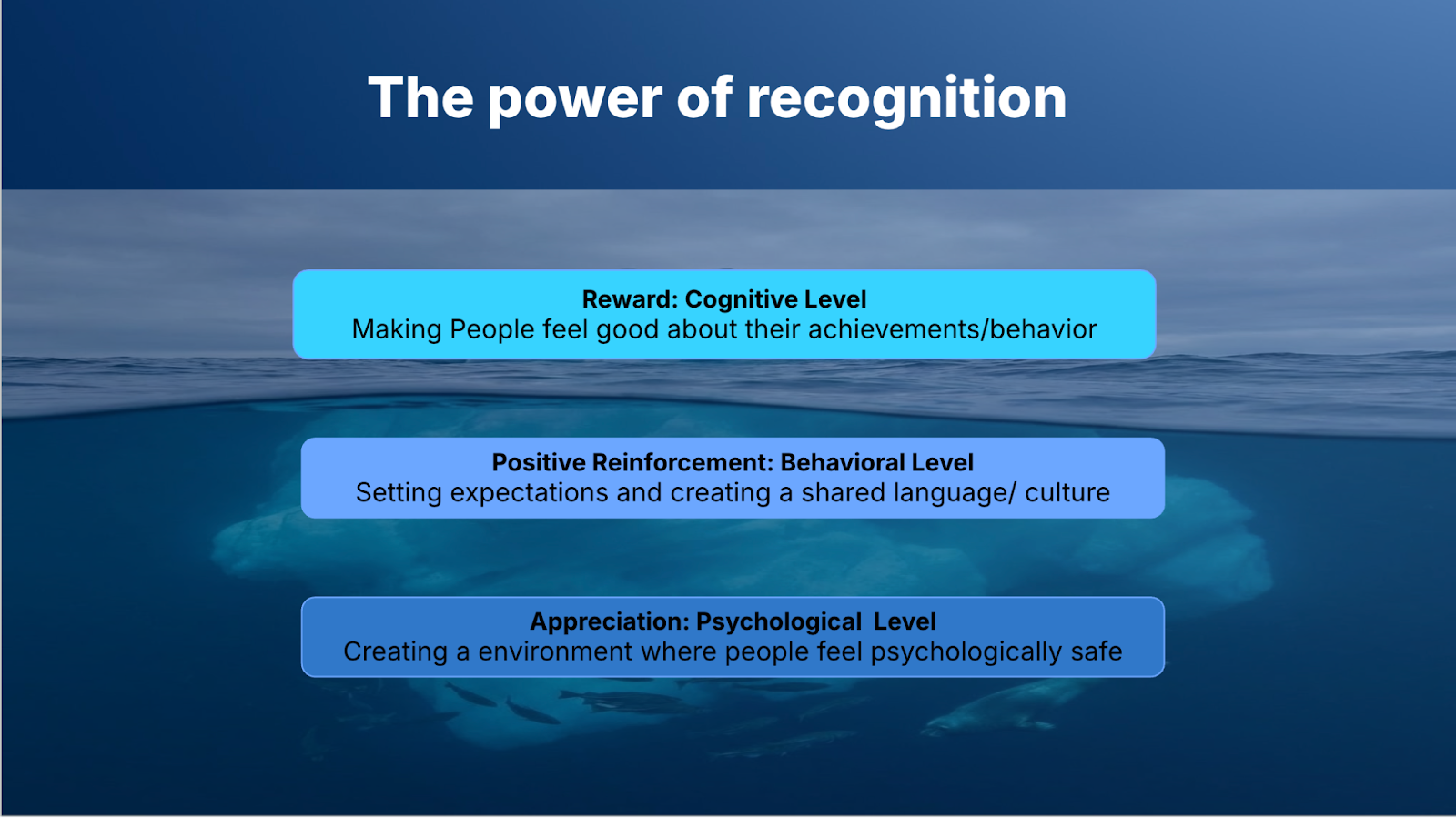
The first layer is rewards, which create a cognitive impact. Rewards acknowledge outcomes and achievements. They answer a very practical question for employees: what behaviors or results are valued here? Rewards can take many forms, from a sincere compliment to compensation, gifts, or public acknowledgment. Regardless of the format, rewards have an immediate effect. Research consistently shows that employees who feel recognized by their managers experience a 14 to 20 percent increase in productivity.
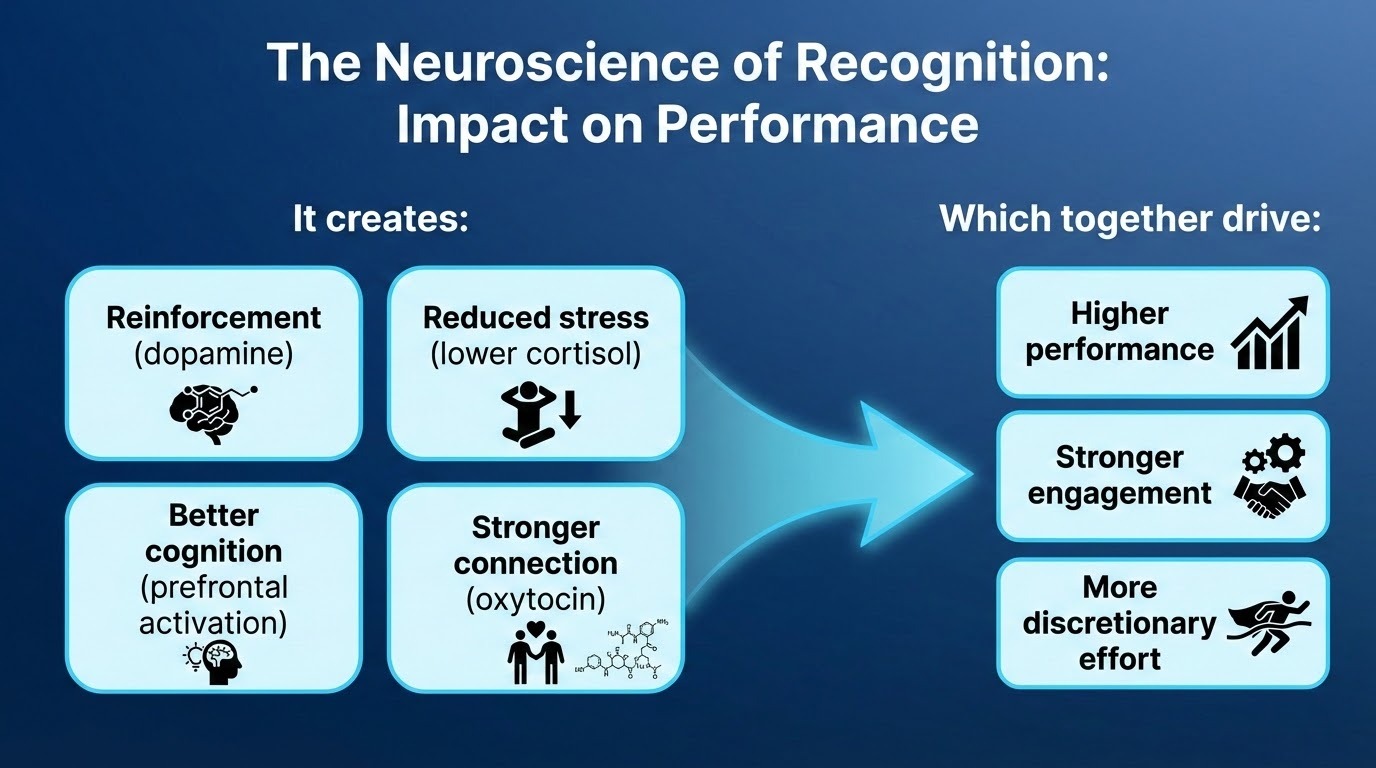
This impact is not accidental. It is neurological. When we receive recognition:
- Dopamine increases, boosting motivation and strengthening learning.
- Cortisol decreases, lowering stress and improving focus.
- Activity in the prefrontal cortex enhances, supporting better planning and problem solving.
- When recognition is warm and personal, oxytocin is released, strengthening trust and human connection.
A simple sentence such as “You really knocked it out of the park leading Project X” or “I’m impressed with the results you achieved this quarter” quite literally changes what happens in the brain in ways that improve performance and deepen relationships.
The second layer is positive reinforcement, which shapes behavior over time. If rewards create an immediate lift, positive reinforcement creates momentum. It answers the question: should I repeat this? Positive reinforcement begins with clear expectations. When leaders intentionally define what good looks like and consistently reinforce it, they create a performance flywheel. Expectations lead to execution. Execution leads to reinforcement. Reinforcement sends a cultural signal. The signal encourages repetition.
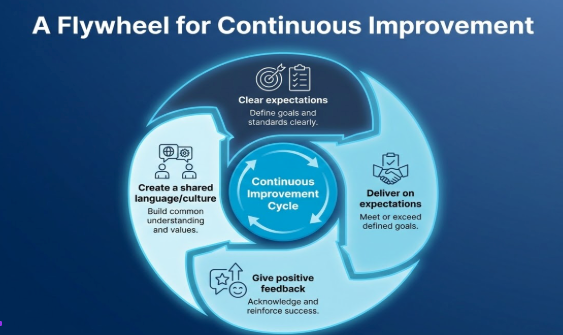
This is intentional leadership. It is the practice of aligning feedback, decisions, and recognition with the behaviors we want to see more of. Instead of simply saying, “Great job leading the project,” we might say, “Your focus on collaboration and teamwork elevated the project from good to great.” Now we are not only celebrating the outcome, but we are reinforcing the behavior. Over time, this shapes culture and drives consistent, repeatable excellence.
The third and deepest layer is appreciation, which creates a psychological impact. Rewards focus on what someone did. Positive reinforcement focuses on how they did it. Appreciation focuses on who they are. It answers the most powerful question of all: am I valued as a person?
This is the foundation of psychological safety, the shared belief that it is safe to speak up, ask questions, share ideas, and even make mistakes. When people feel valued for who they are and not only for what they produce, they take thoughtful risks. They innovate. They collaborate. They stay.
Too often, organizations try to reshape people into what they believe the role requires. It is like trying to turn an elephant into a giraffe. It simply does not work. Both animals are extraordinary in their own way, but their strengths are different. The same is true for people. As researcher and author Tom Rath beautifully said, “You cannot be anything you want to be, but you can be a whole lot more of who you already are.” When we stop trying to change who people are and instead appreciate what they naturally bring, we help them become the best version of themselves. That is when psychological safety truly takes root.
So instead of saying, “Your focus on collaboration and teamwork elevated the project from good to great,” we might say, “You really knocked it out of the park leading Project X. Your inclusive nature and your focus on collaboration and teamwork elevated the project from good to great.” That subtle shift from output to identity builds trust, belonging, and loyalty.
At Snappy, our recognition program is intentionally designed to activate all three layers of recognition. Because leadership is not about being the best. It is about bringing out the best in others.
On this Employee Appreciation Day, we reaffirm our belief that recognition is not a transaction. It is a transformation. When practiced intentionally and personally, it becomes one of the most powerful drivers of performance, culture, and trust.
Thank you for partnering with us in building workplaces where people feel truly seen, valued, and empowered to thrive.

