

It’s that time of year, and if you’re in charge of corporate holiday gifts for your employees, you know it can be tough to secure the budget for a seasonal ask without showing clear ROI.
If you’re in the budget request hot seat this holiday season, this article will show you how to build your pitch, answer leadership’s questions, and demonstrate the long-term value of investing in employee holiday gifts.
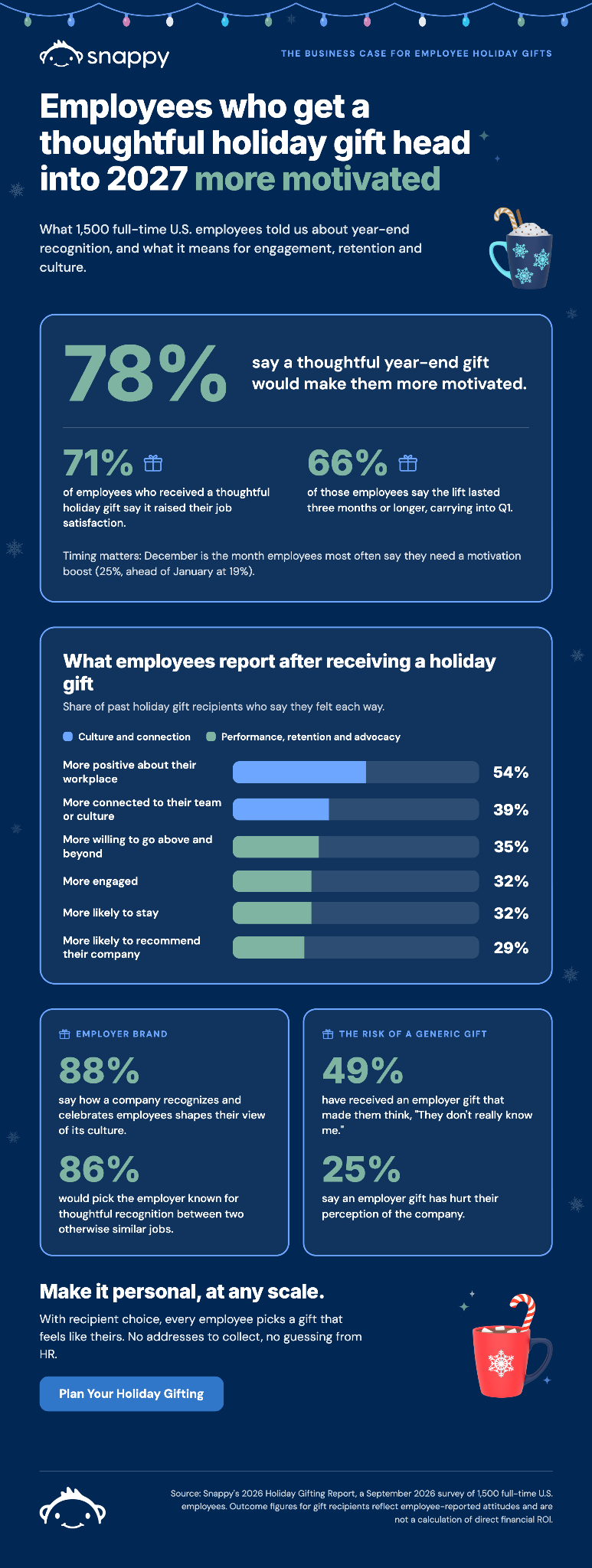
All of the data comes directly from Snappy's 2026 Holiday Gifting Report, based on responses from 1,500 full-time U.S. employees, and shows that employee holiday gifts directly affect motivation, retention, and employer brand. In fact, 78% of employees said a thoughtful year-end gift would motivate them more, and 71% said it increased their job satisfaction.
What Leadership Needs To Hear Before They Say Yes
For HR leaders, the value of employee appreciation is obvious. You live it every day.
When budgets are under review and the ROI impact of competing priorities is being weighed against each other, leadership might need a reminder that employee gifting is actually so much more than a “nice to have.”
A successful pitch for employee holiday gifting budget should answer three key questions:
- Is it worth the investment? According to the 1,500-employee survey, 78% said a thoughtful year-end gift would make them more motivated heading into the new year. 71% of employees who received a thoughtful holiday gift reported increased job satisfaction.
- What does the business gain? Among past holiday gift recipients, approximately one in three reported feeling more engaged or more likely to stay with their employer. Recognition also matters for employer brand: 86% of all respondents said they would be more likely to choose an employer known for thoughtful recognition when comparing otherwise similar jobs.
- Is there a downside to not sending gifts? Nearly half of respondents (49%) had received an employer gift that made them feel like the company didn’t know them at all. 25% said a bad employer gift negatively affected their perception of the company.
The takeaway? The conversation about employee holiday gifts should not be limited to the cost of the gifts. It should include examples of how year-end employee recognition contributes to the company’s success.
Everything You Need On One Page
Snappy’s 2026 Holiday Gifting Report surveyed 1,500 full-time U.S. employees to better understand how year-end recognition influences employee behavior, including motivation, satisfaction, and workplace relationships.
The findings offer HR leaders key talking points for any holiday gifting budget conversations.
A Four-Part Pitch You Can Adapt For Your Leadership Team
Do you want the good news first? You do not need a lengthy presentation to make a compelling case for holiday gifting. What you need is a clear explanation of the opportunity, a realistic budget, and a plan to surface the positive results.
Here are some ideas on how to structure the conversation.
1. Start with the recognition gap
Employees want to feel seen and appreciated, but many aren’t experiencing recognition consistently.
According to Snappy’s research, 84% of employees want to receive a holiday gift from their employer, yet only 57% do. 61% of respondents say that they haven’t felt genuinely appreciated by their company in the last month.
That gap creates a massive opportunity.
A holiday gift won’t replace a strong culture of everyday recognition, but it gives employers a tangible way to acknowledge employees’ contributions and close out the year with appreciation. For employees, that tangible gift becomes a reminder not just of the holiday season, but of the way they felt when they received recognition from their company.
2. Make the connection between recognition and business priorities
Move the discussion from employee sentiment to outcomes that you know leadership already cares about.
Snappy’s survey found that, among employees who previously received holiday gifts from their companies:
- 54% reported feeling more positive about their workplace
- 32% reported feeling more engaged
- 32% reported that they were more likely to stay at their company
These stats illustrate why holiday recognition deserves consideration alongside other employee engagement investments.
3. Make a specific, manageable ask
Your leadership team needs to know what approving a holiday gifting program involves.
Bring a proposal that outlines:
- Employees included: {Number of employees}
- Proposal budget: {$XX -$XX per employee}
- Total investment: {$XX -$XX)
- Delivery window: {Dates}
- Program owner: {Name or Department}
Presenting a defined budget range gives decision-makers something concrete to evaluate. It also demonstrates that HR has considered the operational requirements, not just the employee experience.
4. Have an answer to “What does success look like?”
Commit to reporting on the program.
Choose two or three measures that are practical for your organization. It can be employee engagement scores, retention rates, or the number of employees who claim gifts.
This shifts the conversation from a one-time expense to an initiative with defined objectives and measurable indicators.
A Template: Your Leadership Pitch
We would like to propose a holiday gifting program for {number} employees, with a budget of {$XX -$XX per person} and delivery planned for {date range}.
According to Snappy's 2026 Holiday Gifting Report, 88% of employees say how their company recognizes and celebrates employees shapes their perception of its culture. Among employees who previously received holiday gifts, 54% reported feeling more positive about their workplace, 32% felt more engaged, and 32% felt more likely to stay with their company.
With approval by {Date}, {Owner} will manage the program.
We’ll evaluate participation, employee engagement scores, and retention rates over the next six months to understand the program’s impact.
Responding to the Objections You Might Hear
We all know that even a well-supported proposal might raise questions. Here are five common objections and how to address them.
“Do we really need another employee perk?”
A holiday gift is more than a seasonal perk when it is part of a company’s full suite of recognition programming. In Snappy’s survey, 88% of respondents said that the way a company recognizes and celebrates employees shapes their perception of its culture. That makes recognition relevant to the employee experience, not just the holiday season (and the holiday budget).
“What is the ROI?”
Snappy’s Holiday Gifting Report provides evidence that employees connect thoughtful recognition with motivation, engagement, and loyalty. We can evaluate investment against our own employee feedback, participation, engagement survey, and retention measures.
“Why a gift? Why not a gift card or cash?”
Compensation and recognition serve different purposes. While employees must be paid fairly, compensation doesn't replace expressing gratitude. A thoughtful gift creates a memorable, personal moment of recognition that reminds employees their contributions are valued.
Cash and gift cards certainly have value, but they can feel transactional. A thoughtful gift creates a more personal moment of recognition, one that can extend beyond the initial exchange. Whether it's something an employee uses every day or an experience they'll remember, a gift can serve as a lasting reminder that their contributions are seen and appreciated.
“Can we skip holiday gifts this year?”
This isn’t just about holiday gifts. It’s about your corporate brand. It’s worth considering how employees perceive recognition at other organizations. Among survey respondents, 68% had heard about another employer’s holiday gift and wished their company offered something similar. 86% said they would be more likely to choose an employer known for thoughtful recognition when comparing similar jobs.
“What if employees don’t like what we send?”
This is a fair question. The days of choosing one corporate gift and sending it to everyone are long gone.
Nearly half (49%) of employees have received a gift that made them feel unknown by their company, and 25% said a bad gift hurt their perception of the employer. To avoid this, modern recipient-choice gifting lets employees select their own gifts within a set budget and collection, ensuring everyone receives something they love.
How to measure the impact within your organization
The most important follow-up to a budget request is a committed plan to evaluate what happens after the gifts are sent.
Here are three ways to do exactly that.
1. Employee appreciation scores
A few weeks before sending gifts, ask employees one question: “Do you feel appreciated for your contributions at work?
Now you have a baseline response.
Repeat the question in February and compare responses.
This can help you understand whether employee perception has shifted, although it is important to keep in mind that other workplace elements may contribute to the change.
2. Gift participation and redemption
Track how employees receive, open, and redeem their gifts. Participation helps establish whether the program made a direct impact with your employee base.
Snappy’s gift tracking capabilities help teams monitor gift activity without manually managing gift sends to every recipient.
3. Q1 engagement and retention
Many companies do an employee engagement survey in Q1. Review the scores alongside volunteer turnover numbers for the same period in the previous year.
Yes, these are broader business indicators influenced by many factors, but they can help leadership evaluate recognition as part of the overall employee experience.
Your Employee Holiday Gifting Approval Checklist
Before walking into your next leadership meeting, make sure you have the information needed to move from discussion to decision.
For guidance on delivery windows and important deadlines, check out our holiday gift planning timeline.
If you’re ready to move from approval to gift sends, check out our holiday gift guide for employees.

